List of Penn Perception labs in various Schools at the University of Pennsylvania.
Research Papers:
Wu W, Kim YJ, Dacey DM, Troy JB, Smith RG (2023) Two mechanisms for direction selectivity in a model of the primate starburst amacrine cell. Vis Neurosci. 40:E003.
https://doi.org/10.1017/S0952523823000019
Huang X, Kim AJ, Ledesma HA, Ding J, Smith RG, Wei W (2022) Visual Stimulation Induces Distinct Forms of Sensitization of On-Off Direction-Selective Ganglion Cell Responses in the Dorsal and Ventral Retina. J Neurosci. 42:4449-4469; https://pubmed.ncbi.nlm.nih.gov/35474276
Kim YJ, Peterson BB, Crook JD, Joo HR, Wu J, Puller C, Robinson FR, Gamlin PD, Yau K-W, Viana F, Troy JB, Smith RG, Packer OS, Detwiler PB, Dacey DM (2022) Origins of direction selectivity in the primate retina. Nature Commun. 13,2862 https://www.nature.com/articles/s41467-022-30405-5.pdf.
Jain V, Hanson L, Sethuramanujam S, Michaels T, Gawley J, Gregg RG, Pyle I, Zhang C, Smith RG, Berson D, McCall MA, Awatramani GB (2022) Gain control by sparse, ultra-slow glycinergic synapses. Cell Rep. 38:110410. https://doi.org/10.1016/j.celrep.2022.110410.
Behrens C, Yadav SC, Korympidou MM, Zhang Y, Haverkamp S, Irsen S, Schaedler A, Lu X, Liu Z, Lause J, St-Pierre F, Franke K, Vlasits A, Dedek K, Smith RG, Euler T, Berens P, Schubert T (2022) Retinal horizontal cells use different synaptic sites for global feedforward and local feedback signaling Current Biology. 32:545-558.e5. doi: 10.1016/j.cub.2021.11.055.
Hellmer CB, Hall LM, Bohl JM, Sharpe ZJ, Smith RG, Ichinose T (2021) Cholinergic feedback to bipolar cells contributes to motion detection in the mouse retina. Cell Reports 37:110106. doi: 10.1016/j.celrep.2021.110106.
Chen Q, Smith RG, Huang X, Wei W (2020) Preserving inhibition with a disinhibitory microcircuit in the retina. eLife 2020;9:e62618. doi: 10.7554/eLife.62618.
Oesterle J, Behrens C, Schröder C, Hermann T, Euler T, Franke K, Smith RG, Zeck G, Berens P. (2020) Bayesian inference for biophysical neuron models enables stimulus optimization for retinal neuroprosthetics. eLife 2020;9:e54997. doi: 10.7554/eLife.54997.
Bligard GW, DeBrecht J, Smith RG, Lukasiewicz PD (2020) Light-Evoked Glutamate Transporter EAAT5 Activation Coordinates with Conventional Feedback Inhibition to Control Rod Bipolar Cell Output. J Neurophysiol. 123:1828-1837. doi: 10.1152/jn.00527.2019.
Percival KA, Venkataramani S, Smith RG, Taylor WR (2019) Directional Excitatory Input to Direction-Selective Ganglion Cells in the Rabbit Retina. J Comp Neurol. 2019 Jan 1; 527:270-281. doi: 10.1002/cne.24207.
Borghuis BG, Ratliff CP, Smith RG (2018) Impact of light-adaptive mechanisms on mammalian retinal visual encoding at high light levels. J Neurophysiol 119:1437-1449. doi: 10.1152/jn.00682.2017
Howlett MH, Smith RG, Kamermans M (2017) A novel mechanism of cone photoreceptor adaptation. PLoS Biol. 2017 Apr 12;15(4):e2001210. doi: 10.1371/journal.pbio.2001210.
Ding H, Smith RG, Poleg-Polsky A, Diamond JS, Briggman KL (2016) Species-specific wiring for direction selectivity in the mammalian retina. Nature 535:105-110, doi:10.1038/nature18609
Stincic T, Smith RG, Taylor WR (2016) Time-course of EPSCs in On-type starburst amacrine cells in mouse retina is independent of dendritic location. J. Physiol. 594:5685-5694, doi: 10.1113/jp272384.
Lipin MY, Taylor WR, Smith RG. (2015) Inhibitory Input to the Direction Selective Ganglion Cell Is Saturated at Low Contrast. J. Neurophysiol. (2015) 114:927-941. doi: 10.1152/jn.00413.2015.
Trenholm S, McLaughlin AJ, Schwab DJ, Turner MH, Smith RG, Rieke F, Awatramani GB. (2014) Nonlinear dendritic integration of electrical and chemical synaptic inputs drives fine-scale correlations. Nat Neurosci.17(12):1759-66. doi: 10.1038/nn.3851.
Puthussery T, Venkataramani S, Gayet-Primo J, Smith RG, Taylor WR (2013) NaV1.1 Channels in axon initial segments of retinal bipolar cells augment input to magnocellular visual pathways. J Neurosci 33(41): 16045-16059, doi: 10.1523/jneurosci.1249-13.2013.
Abbas SY, Hamade KC, Yang EJ, Nawy S, Smith RG, Pettit DL (2013) Directional Summation in non-Direction Selective Retinal Ganglion Cells. PLoS Comput Biol. 9(3):e1002969. doi: 10.1371/journal.pcbi.1002969.
Nikonov SS, Lyubarsky A, Fina ME, Nikonova ES, Sengupta A, Chinniah C, Ding X-Q, Smith RG, Pugh EN Jr, Vardi N, Dhingra A. (2013) Cones Respond to Light in the Absence of Beta Transducin Subunit, J Neurosci 33:5182-5194.
Taylor WR, Smith RG (2012)
The role of starburst amacrine cells in visual signal processing, Visual Neuroscience 29:73-81.
Trenholm S, Johnson K, Li X, Smith RG, Awatramani GB (2011)
Parallel Mechanisms Encode Direction in the Retina, Neuron 71:683-694
DOI 10.1016/j.neuron.2011.06.020
Schachter MJ, Oesch N, Smith RG, Taylor WR. (2010)
Dendritic Spikes Amplify the Synaptic Signal to Enhance Detection of Motion in a Simulation of the Direction-Selective Ganglion Cell. PLoS Comput Biol 6(8): e1000899. doi:10.1371/journal.pcbi.1000899.
Lipin MY, Smith RG, Taylor WR. (2010)
Maximizing contrast resolution in the outer retina of mammals.
Biol Cybern. 103:57-77.
Borghuis, B.G., Sterling, P. and Smith, R.G. (2009)
Loss of sensitivity in an analog neural circuit. J Neurosci 29: 3045-3058.
Yin L, Smith, R.G., Sterling, P. and Brainard D.H (2009)
Physiology and morphology of color-opponent ganglion cells in a
retina expressing a dual gradient of S and M opsins.
J Neurosci 29: 2706-2724.
Xu, Y, Sulaiman, P, Fedderson, R., Liu, J.,
Smith, R.G. and Vardi, N. (2008)
Retinal On- bipolar cells express a new PCP-2 splice variant that accelerates the light response.
J Neurosci 28:8873-8884.
Borghuis BG, Ratliff CP, Smith RG, Sterling P,
Balasubramanian V. (2008) Design of a neuronal array. J Neurosci 28:3178-3189.
Yin L, Smith RG, Sterling P, Brainard DH
(2006) Chromatic properties of horizontal and ganglion cell
responses follow a dual gradient in cone opsin expression.
J Neurosci 26:12351-12361.
Dhingra NK, Freed, MA, Smith RG
(2005) Voltage-gated sodium channels improve contrast sensitivity of a retinal
ganglion cell. J Neurosci 25:8097-8103.
Xu Y, Dhingra NK, Smith RG, Sterling P
(2005) Sluggish and brisk ganglion cells detect contrast with similar
sensitivity. J Neurophsiol 93:2388-2395.
Berntson A, Smith RG, Taylor WR
(2004) Postsynaptic calcium feedback between rods and rod bipolar
cells in the mouse retina. Visual Neurosci 21:913-924.
Berntson A, Smith RG, Taylor WR
(2004) Transmission of single photon signals through a binary
synapse in the mammalian retina.
Visual Neurosci 21:693-702.
Taylor WR, and Smith RG
(2004) Transmission of scotopic signals from the rod to
rod-bipolar cell in the mammalian retina.
Vision Res. (2004) 44: 3269-3276.
Tukker JJ, Taylor WR, and
Smith, RG. (2004) Direction selectivity in a model of the
starburst amacrine cell. Visual Neurosci. (2004)21: 611-625.
Dhingra NK, and Smith RG
(2004) Spike generator limits efficiency of information transfer in a
retinal ganglion cell J. Neurosci. (2004) 24: 2914-2922.
Freed, M.A., Smith,
R.G., and Sterling, P. (2003) Timing of quantal release from
the retinal bipolar terminal is regulated by a feedback circuit.
Neuron, 38: 89-101.
van Rossum, M.C.W.,
O'Brien, B., and Smith, R.G. (2003) Effects of noise on the spike
timing precision of retinal ganglion cells. J. Neurophysiol. 89:2406-2419.
Dhingra, N.K., Kao, Y.-H., Sterling,
P., and Smith, R. (2003) Contrast threshold of a
brisk-transient ganglion cell in vitro. J. Neurophysiol.
89:2360-2369.
DeVries S, Qi X-F, Smith R,
Makous W, and Sterling, P. (2002) Electrical
coupling enhances contrast sensitivity of foveal cones.
Current Biology 12:1900-1907.
Hsu, A., Smith, R.G.,
Buchsbaum, G., and Sterling, P. (2000) Cost of coupling to
trichomacy in foveal cones. J Optical Soc. Am. A 17:(3) 635-640.
van Rossum, M.C.W., and
Smith, R.G. (1998) Noise removal at the rod synapse of
mammalian retina. Visual
Neurosci., 15: 809-821.
Hsu, A., Tsukamoto, Y.,
Smith, R.G., and Sterling, P (1998) Functional architecture
of primate cone and rod axons. Vision Research 38:
2539-2549.
Vardi, N. and Smith, R.G.
(1996) The AII amacrine array: coupling can increase
correlated activity. Vision Res. 36: 3743-3757.
Smith, R.G. (1995)
Simulation of an anatomically-defined local circuit: the
cone-horizontal cell network in cat retina. Visual Neurosci., 12:
545-561.
Smith, R.G., and Vardi, N.
(1995) Simulation of the AII amacrine cell in cat retina:
Functional consequences of electrical coupling and regenerative
membrane properties. Visual Neurosci., 12: 851-860.
Hsu, A., and Smith, R.G. (1994) Simulating the foveal cone
receptive field. In: Computation in Neurons and Neural Systems,
Ed. by Frank H. Eeckman. Kluwer Academic Publishers, Boston.
Smith, R.G. (1994)
Measurement of simulation speed: its relation to simulation
accuracy. In: Computation in Neurons and Neural Systems, Ed. by
Frank H. Eeckman. Kluwer Academic Publishers, Boston.
Freed, M.A., Smith, R.G., and
Sterling, P. (1992) Computational model of the on-alpha ganglion
cell receptive field based on bipolar cell circuitry. Proc. Nat.
Acad. Sci. 89: 236-240.
Smith, R.G.(1992) NeuronC:
a computational language for investigating functional
architecture of neural circuits. J. Neurosci. Meth 43: 83-
108.
Sterling, P., Cohen, E.,
Smith, R.G., and Tsukamoto, Y. (1992) Retinal circuits for
daylight: why ballplayers don't wear shades. In: Analysis and
Modeling of Neural Systems, Ed. by Frank H. Eeckman. Kluwer
Academic Publishers.
Tsukamoto, Y., Smith, R.G., and Sterling, P. (1990)
"Collective coding" of correlated cone signals in the retinal ganglion cell.
Proc. Nat. Acat. Sci. 87: 1860-1864.
Smith, R.G., and Sterling, P. (1990)
Cone receptive field in cat retina computed from microcircuitry.
Visual Neurosci. 5: 453-461.
Sterling, P., Freed, M.A., and Smith, R.G. (1988)
Architecture of the rod and cone circuits to the On-beta ganglion
cell. J. Neurosci. 8:623- 642.
Smith, R.G. (1987) Montage:
a system for three-dimensional reconstruction by personal
computer. J. Neurosci. Meth. 21:55-69.
Sterling, P., Cohen, E., Freed,
M.A., and Smith, R.G. (1987) Microcircuitry of the on-beta
ganglion cell in daylight, twilight and starlight. Neurosci.
Research, Suppl. 6, S269-S285.
Freed, M.A., Smith, R.G.,
and Sterling, P. (1987) Rod bipolar array in the cat retina:
pattern of input from rods and GABA-accumulating amacrine cells.
J. Comp. Neurol. 266: 445-455.
Smith, R.G., Freed, M.A.,
and Sterling, P. (1986) Microcircuitry of the dark-adapted cat
retina: Functional architecture of the rod-cone network. J.
Neurosci 6:3505-3517.
Sterling, P., Freed, M.A.,
and Smith, R.G. (1986) Microcircuitry and functional architecture
of the cat retina. Trends in Neurosci. 9:186-192.
Kauffman, S.A., and Smith, R.G. (1986) Adaptive automata
based on darwinian selection. Physica 22D:68-82.
Reviews, Chapters and Symposia proceedings:
Smith R.G. (2024) Cone Photoreceptor Cells: Soma and Synapse. In Reference Module in Neuroscience and Biobehavioral Psychology, Elsevier. https://doi.org/10.1016/B978-0-443-13820-1.00045-1
Smith RG. (2024) Rod Photoreceptor Cells: Soma and Synapse. In Reference Module in Neuroscience and Biobehavioral Psychology, Elsevier. https://doi.org/10.1016/B978-0-443-13820-1.00044-X
Smith R.G. (2018) Cone Photoreceptor Cells: Soma and Synapse. In Reference Module in Neuroscience and Biobehavioral Psychology, Elsevier, 2018. ISBN 9780128093245. http://dx.doi.org/10.1016/b978-0-12-809324-5.21547-2
Krizaj D, Smith RG. (2017) Rod Photoreceptor Cells: Soma and Synapse. In Reference Module in Neuroscience and Biobehavioral Psychology, Elsevier, 2017. ISBN 9780128093245. http://dx.doi.org/10.1016/B978-0-12-809324-5.01516-9
Smith RG, Delaney KR, Awatramani GB (2014) Post-receptor adaptation:
lighting up the details. Curr Biol. 24(13):R608-10. doi:
10.1016/j.cub.2014.05.058.
Smith RG, Taylor WR (2013) Dendritic Computation of Direction in Retinal
Neurons. In Eds: Cuntz H, Remme MWH, Torben-Nielsen B The Computing Dendrite:
From Structure to Function, Springer Series in Computational Neuroscience,
ISBN-13: 978-1461480938
Taylor WR, Smith RG. (2012)
The role of starburst amacrine cells in visual signal processing.
Vis Neurosci. 29(1):73-81.
Taylor WR, Smith RG. (2011)
Trigger features and excitation in the retina, Curr
Opin Neurobiol, 21:672-678. doi:10.1016/j.conb.2011.07.001
Smith, R.G. (20010b)
Rod photoreceptor cells: soma and synapse. In Eds,
Besharse J, Dana R, and Dartt DA, et al, Encyclopedia of the Eye,
4-volume set, May, 2010, Academic Press, ISBN-13: 9780123741981.
Smith, R.G. (20010a)
Cone photoreceptor cells: soma and synapse. In Eds,
Besharse J, Dana R, and Dartt DA, et al, Encyclopedia of the Eye,
4-volume set, May, 2010, Academic Press, ISBN-13: 9780123741981.
Smith, R.G. and Dhingra, N.K. (2009)
Ideal observer analysis of signal quality in retinal circuits.
Prog Ret Eye Research. 28:263-288. Epub 2009 May 13.
Smith, R.G. (2008) Contributions
of Horizontal Cells. In: Allan I. Basbaum, Akimichi Kaneko,
Gordon M. Shepherd, and Gerald Westheimer (Editors) The Senses: A
Comprehensive Reference, Vol 1, Vision I, Richard Masland, and
Thomas D Albright, Eds. San Diego, Academic Press, p 348-350.
Dhingra NK, Smith R, Sterling
P (2003) Psychophysics to biophysics: how perception depends
on circuits, synapses, and vesicles. In: A. Kaneko (Ed) The
Neural Basis of Early Vision. Keio University International
symposia for Life Sciences and Medicine, Springer-Verlag, Tokyo,
Vol. 11.
Smith, R.G. (2003) Retina.
In: Michael A. Arbib (Ed.): The Handbook of Brain Theory and
Neural Networks (second ed). MIT Press.
Smith RG, Dhingra NK, Kao YH,
Sterling P (2001) How efficiently a ganglion cell codes the
visual signal. Proc. IEEE Eng. Med. Biol. Soc., IEEE,
Piscataway, NJ, Vol. 1, pp 663-665.
Sterling, P., Smith, R.G., Rao,
R., and Vardi, N. (1995) Functional architecture of
mammalian outer retina and bipolar cells. In: Archer S.,
Djamgoz, M.B.A., and Vallerga, S. (Eds.): Neurobiology of the
vertebrate outer retina. Chapman & Hall, Ltd., London.
Alternative Media:
Smith, R.G. Neuron-C - A simulation language for testing
hypotheses about neural performance.

 Adjunct Associate Professor
 RESEARCH TECHNIQUES:
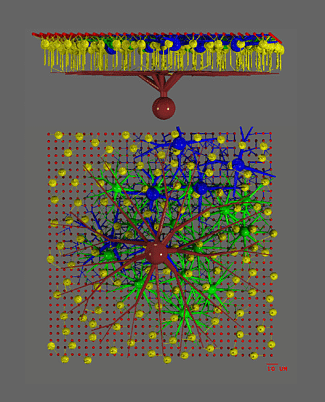
Analysis of the role of synaptic and biophyical properties, morphology, and
noise in a neural circuit's performance. Electrophysiological recordings.
Computer simulation of neural circuitry. Ideal observer analysis of neural
circuit performance.
RESEARCH TECHNIQUES:
Analysis of the role of synaptic and biophyical properties, morphology, and
noise in a neural circuit's performance. Electrophysiological recordings.
Computer simulation of neural circuitry. Ideal observer analysis of neural
circuit performance.